


Strategic Foundations of Website Quality
In the "post-pandemic new digital consumer" era, a brand’s website is the undisputed central hub of its online existence. Strategists must recognise the high-stakes environment: 85% of consumers conduct online research before purchasing, and 74% utilize websites as their primary research channel. The cost of failure is absolute since 57% of users will abandon or refuse to recommend a brand due to poor web design, whereas 86% of customers are willing to pay a premium for a superior, immersive experience.
To manage this, architects of the digital experience must synthesize the Online Customer Experience (OCE). The subjective psychological response a consumer has to a digital presentation. Strategists must ruthlessly distinguish between "site interface features" (the raw technical elements like colour, font size, and background audio) and "site atmospheric cues" (the resulting psychological perceptions of informativeness, effectiveness, and entertainment). Interface features are merely the "what"; atmospheric cues are the "how it feels" and the true drivers of consumer affect. OCE is comprised of four critical dimensions:
• Cognitive: The user’s mental processing, including evaluations of information quality and beliefs regarding the site’s ability.
• Affective: The emotional response, encompassing feelings of pleasure, arousal, or satisfaction.
• Social: The sense of warmth and community, often facilitated by user-generated content or virtual agents.
• Sensory: The user’s response to visual appeal, telepresence and the strategic lever defined as the immersive feeling of being "present" in the digital environment rather than merely observing it.
The Five-Stage Evolution of Website Quality
Digital reputation is not a static destination but an evolving maturity model. To future-proof a brand, one must navigate five sequential themes of website quality:
1. Usability: Grounded in ISO 9241-11, prioritizing efficiency (resource consumption), effectiveness (task completion quality), and user satisfaction.
2. Information: Distinguishing between content "information quality" and technical "system quality" (performance and design).
3. Interactivity (Web 2.0): Transforming the site into a two-way social servicescape via user-generated content, blogs, and direct response mechanisms.
4. Mobility: Implementing responsive design to ensure parity across diverse mobile devices.
5. Intelligence (Web 3.0): Utilizing semantic networks and search capabilities that simulate natural conversation to link users into a global intelligence network.
Protocol for Automated Quality Assessment
The following Automated Evaluation Metrics (based on the Website Grader® framework) serve as the foundation for the digital reputation audit:
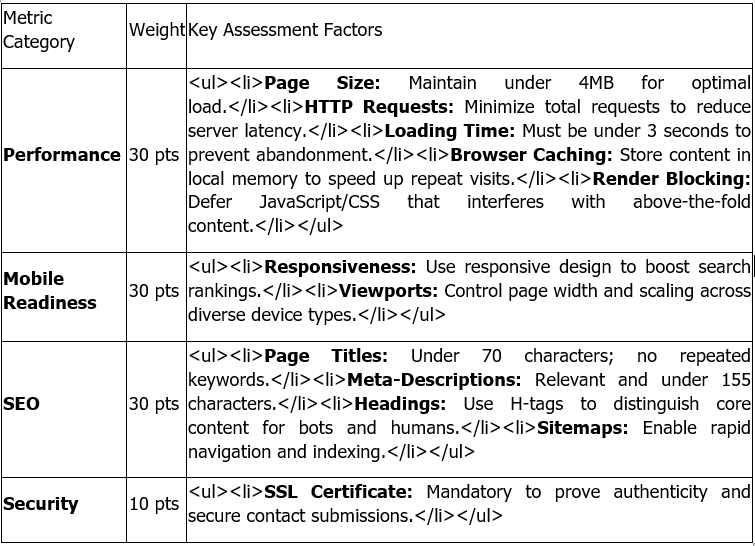
Automated tools are superior for "system quality" and technical usability; however, they cannot evaluate the resonance of marketing content or the emotional storytelling of a brand. Strategists must use these scores as a technical baseline while manually auditing the customer journey's psychological impact.
Managing the Customer Journey: A Lifecycle Approach
Online Customer Experience is dynamic. It must be managed with shifting priorities across the three stages of the customer journey:
• Pre-Purchase Stage: Focus on driving telepresence and "fantasy" to build intention. A critical lever here is Web-brand extension similarity and the site’s ability to help consumers recognise the brand’s fit and credibility when expanding into new categories.
• Purchase Stage: Prioritize "site convenience" and "ease of use." Even the most entertaining pre-purchase environment is worthless if the transaction interface is complex.
• Post-Purchase Stage: Shift toward "social support," "brand communities," and high "responsiveness" to complaints. This drives loyalty and positive electronic word-of-mouth (e-WOM).
The Negation Risk Architects must monitor the transition between stages. A failure in "site effectiveness" (technical friction) at the purchase stage will completely negate the high "site entertainment" value built during the pre-purchase stage. High task-relevant cues (security and speed) must remain robust to prevent "avoidance behaviors."
Strategic Governance Checklist
To eliminate human rater bias and ensure methodological rigor, e-commerce managers must audit the following:
• Theoretical Alignment: Does the architecture support "Flow" and "Perceived Control"?
• Evolutionary Progress: Where does the site sit on the roadmap (Usability → Intelligence)?
• Metric Integrity: Are automated web crawlers being deployed regularly to provide objective performance data?
• Lifecycle Balance: Are we over-indexed on Low Task-Relevant cues (Entertainment) while neglecting High Task-Relevant requirements (Security/Performance) in the Purchase stage?
The synthesis of qualitative site atmospherics and quantitative automated metrics creates a defensible, high-value online customer experience. By aligning architecture with the multidimensional journey, brands move beyond transactions to create resilient, loyal consumer relationships.
Website design and management recommendations
1. Website Design and First Impressions
• Prioritize Inspiration: Visual appeal and inspiration are the primary drivers of a favourable first impression, which can convert "lookers" to "users".
• Persuasive Architecture: Managers should move beyond merely providing information and usability to incorporating persuasive tools that influence the decision-making process.
• Immediate Impact: Because visual appeal is often assessed in less than a second, design elements must provide obvious cues of quality with minimal mental effort.
• Reflect Brand Image: Website design, including logos and high-resolution media, should consistently reflect the brand's implied image to improve brand memory.
2. Information and Task Alignment
• Ensure Information-Task Fit: A website must provide the specific information a user needs to complete a given task, rather than just high volumes of general information.
• Information as a Quality Signal: Potential buyers often infer product quality from the quality of the website's design and information. High information-task fit has a stronger influence on perceived product quality than overall design quality.
• Content Relevance: Providing up-to-date, in-depth, and accurate product and price information is one of the strongest factors for inducing online purchases.
3. Enhancing User Experience and "Flow"
• Facilitate Flow Opportunities: Managers should design environments that encourage "flow" which is a state of complete engagement and immersion, which leads to increased learning and positive subjective experiences.
• Dynamic Challenge: In complex environments like virtual worlds, managers should offer dynamic levels of challenge that skills can meet, fostering long-term loyalty and "cognitive lock-in".
• Interactive Control: The transition to Web 2.0 means consumers expect much more freedom and control over their online navigational experiences.
• Social and Social Networking Features: Integrating social features (like Facebook or customer communities) can enhance interactivity, strengthen site credibility, and provide trusted alternative information sources.
4. Trust and Security Management
• Build eTrust: Perceived trust is a critical mediator between website quality and booking intentions. Usability, entertainment value, and channel complementarity all contribute to building this trust.
• Communicate Security and Privacy: Companies must actively convey the safety of their payment systems, delivery, and return processes to overcome consumer privacy barriers.
• Utilise Trust Signals: Incorporating official seals, trust marks, or neutral-source awards can significantly improve perceived trustworthiness during an initial visit.
5. Personalisation as Persuasion
• High-Quality Preference Matching: Personalization strategies are most effective when they accurately match content to a user’s specific tastes, which induces deeper cognitive processing and selection.
• Manage Recommendation Sets: The size of recommendation sets and the use of sorting cues (like "most popular") are peripheral variables that can successfully capture user attention.
• Understand User Personality: Managers should adapt personalisation strategies based on individual traits, such as a user's "need for cognition," to maximize persuasive impact.
6. Journey-Stage and Cultural Tailoring
• Identify Journey Stages: Marketing strategies should differ depending on whether a customer is in the pre-purchase (focus on attitude), purchase (focus on flow/interactivity), or post-purchase (focus on satisfaction/loyalty) stage.
• Cultural Adaptation: Website design and communication should be adapted to the local culture. For example, in cultures with high uncertainty avoidance, social influence and subjective norms (like reviews) play a much larger role in purchase intention.
7. Evaluation and Benchmarking
• Use Automated Tools: Especially for SMEs, automated evaluation tools are cost-effective ways to benchmark against competitors, reduce rater bias, and identify technical shortfalls in performance, SEO, or mobile readiness.
• Adopt Multi-Modal Measurement: Managers should use a combination of direct self-reports, multi-item scales (like WebQual), and structural models to gain a fine-grained understanding of their site's effectiveness.
• Incorporate the "Voice of the Customer": Permitting customers to rate site appeal before a public launch allows for early corrective action on design shortfalls.
References
Dedeke, A.N., 2016. Travel web-site design: Information task-fit, service quality and purchase intention. Tourism management, 54, pp.541-554.
Hoffman, D.L. and Novak, T.P., 2009. Flow online: lessons learned and future prospects. Journal of interactive marketing, 23(1), pp.23-34.
Kim, H. and Fesenmaier, D.R., 2008. Persuasive design of destination web sites: An analysis of first impression. Journal of Travel research, 47(1), pp.3-13.
Koronaki, E., Vlachvei, A. and Panopoulos, A., 2023. Managing the online customer experience and subsequent consumer responses across the customer journey: A review and future research agenda. Electronic Commerce Research and Applications, 58, p.101242.
Lee, Y. and Kozar, K.A., 2012. Understanding of website usability: Specifying and measuring constructs and their relationships. Decision support systems, 52(2), pp.450-463.
Li, L., Peng, M., Jiang, N. and Law, R., 2017. An empirical study on the influence of economy hotel website quality on online booking intentions. International Journal of Hospitality Management, 63, pp.1-10.
Zerbini, C., Bijmolt, T.H., Maestripieri, S. and Luceri, B., 2022. Drivers of consumer adoption of e-Commerce: A meta-analysis. International Journal of Research in Marketing, 39(4), pp.1186-1208.