


The Hierarchy of Social Media Performance Metrics
In high-performance digital architecture, the strategic value of a post is defined not by its mere presence, but by its capacity to elicit explicit user feedback. Strategists must mandate a sharp distinction between passive visualizations and active interactions. Moving beyond "vanity metrics" to stronger measures of user intent is a strategic necessity for building brand trust and recognition. While visualizations indicate a potential for exposure, only interactions provide the empirical evidence of the cognitive and affective impact required for brand building.
The following conceptual map categorizes performance metrics extracted from the Facebook environment, distinguishing between simple visibility and meaningful engagement.
Conceptual Map of Social Media Performance Metrics
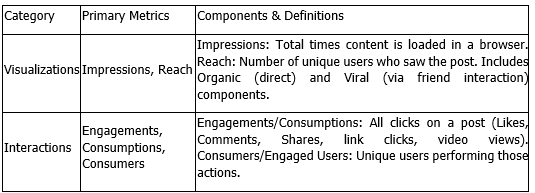
The "So What?" Layer: Intent vs. Exposure The fundamental differentiator between "Impressions" and "Engagements" is the degree of user attention. Loading content on a browser is a passive event and does not equate to cognitive processing. Conversely, a click represents an explicit user action that moves the consumer through the three stages of the branding hierarchy:
• Cognitive Stage: Driven by Reach (unique users), establishing brand awareness.
• Affective Stage: Driven by Interactions (Likes and positive feedback), establishing brand attachment and satisfaction.
• Conative Stage: Driven by Engagements and high-volume discussion, establishing purchase intention.
These metrics serve as the raw data for the predictive modeling required to move from reactive reporting to proactive strategy.
Social Media Creative Strategy: Vividness, Interactivity, and Message Appeals
Social media activity must be "user-centered" rather than "message-centered." The choice of creative appeal acts as a bridge between the brand’s goals and the consumer’s psychological needs for information or entertainment. Technical drivers get content into the feed, but creative execution gets the brand into the mind.
The formal features of a post dictate the nature of the engagement:
• Vividness: High vividness (Video) stimulates multiple senses, significantly increasing the volume of Likes.
• Interactivity: High interactivity (Questions) is the primary driver of Comments.
• The "Link Trap" Warning: Including a "Link to website" has a documented negative effect on comments. Because links navigate users away from the platform, they effectively kill the on-page dialogue. Strategists must avoid links if community conversation is the primary KPI.
Creative teams must distinguish between two primary appeal types:
• Functional/Informational: Rational focus on utility and selling propositions.
• Transformational/Emotional: Focus on experiential, image-focused, and exclusivity-based messaging.
The Engagement Correlation: While functional messages are common, experiential and image-focused appeals correlate more highly with engagement. These messages transform the relationship from transactional to interactional, making the brand a component of the consumer's identity.
Incentives drive "influence impressions" (social word-of-mouth).
• Contests vs. Discounts: Contests are superior for top-tier brands as they foster active participation and sensory immersion. Simple discounts often attract price-sensitive users rather than building brand equity.
Managing Social Dynamics and Social Media Post Positioning
Once live, a post is subject to "Social Contagion," where existing user interactions act as mindset enablers for subsequent viewers. Community management is not just service; it is the active management of social feedback loops.
Strategists must interpret comment valence (sentiment) as a tool for engagement volume:
• Positive Valence: Enhances brand post attractiveness and directly correlates with a higher number of Likes.
• Negative Valence: Contrary to instinct, negative comments are not inherently "bad." They trigger differentiation and rebuttals from other community members. This conflict generates a higher volume of subsequent comments, fuelling the conative stage of branding by keeping the brand in the foreground of a vivid discussion. Strategists must not delete negative comments (unless they violate the platform community guidelines), as they are essential fuel for community engagement.
Cumulative reach and interactions are strongly correlated with the number of days a post remains at the "Top Position" (the most recent or pinned post). Strategists must manage the publication calendar to ensure high-performing assets are not "buried" too quickly by new content, thereby maximizing their long-tail visibility.
Recommendations for Social Media Content and Message Strategy
Managers are encouraged to shift from purely promotional content toward strategies that stimulate genuine engagement.
• Prioritise Transformational Messages: Use transformational message strategies (focused on emotions, brand resonance, and sensory experiences) more frequently, as these are identified as the most powerful drivers of consumer behavioral engagement.
• Employ Combined Message Strategies: To enhance effectiveness, complement purely informational or interactional messages with transformational elements. For example, instead of a standard functional post, marketers should add brand heritage or sensory cues.
Select High-Impact Post Formats:
"Status" posts on Facebook are noted for capturing significantly more attention than links, photos, or videos.
Vivid content like videos and interactive elements like contests are effective for increasing the number of "likes".
Interactive questions are specifically recommended to enhance the number of "comments".
• Optimize for Specific Platforms: On Instagram, events and promotions are recommended for driving higher follower involvement. For Facebook, event posts are particularly effective for generating "likes".
• Leverage Seasonality and Context: Align posting schedules with industry-specific seasonality. Managers should also focus on content that provides hedonic benefits or relates to consumers' day-to-day lives rather than just direct commercial price/product information.
References:
Agnihotri, R., Bakeshloo, K.A. and Mani, S., 2023. Social media analytics for business-to-business marketing. Industrial Marketing Management, 115, pp.110-126.
Ashley, C. and Tuten, T., 2015. Creative strategies in social media marketing: An exploratory study of branded social content and consumer engagement. Psychology & marketing, 32(1), pp.15-27.
Coelho, R.L.F., Oliveira, D.S.D. and Almeida, M.I.S.D., 2016. Does social media matter for post typology? Impact of post content on Facebook and Instagram metrics. Online Information Review, 40(4), pp.458-471.
De Vries, L., Gensler, S. and Leeflang, P.S., 2012. Popularity of brand posts on brand fan pages: An investigation of the effects of social media marketing. Journal of interactive marketing, 26(2), pp.83-91.
Holsapple, C.W., Hsiao, S.H. and Pakath, R., 2018. Business social media analytics: Characterization and conceptual framework. Decision Support Systems, 110, pp.32-45.
Moro, S., Rita, P. and Vala, B., 2016. Predicting social media performance metrics and evaluation of the impact on brand building: A data mining approach. Journal of Business Research, 69(9), pp.3341-3351.
Peters, K., Chen, Y., Kaplan, A.M., Ognibeni, B. and Pauwels, K., 2013. Social media metrics—A framework and guidelines for managing social media. Journal of interactive marketing, 27(4), pp.281-298.